The Dungeons and Dragons Fourth Edition Preview Books 378
It's a big year for tabletop gamers. In just a few months the first books for the Fourth Edition of Dungeons and Dragons (D&D) will be released by publisher Wizards of the Coast (WotC). The last major update to the game rules was released in 1999, and sparked interest in D&D not seen since the early 80s. To attempt to answer some of the biggest questions about this newest edition, WotC has learned from mistakes made in 99', and is previewing their game updates with a pair of softcover books. Called "Races and Classes" and "Worlds and Monsters", the two titles cover everything from character creation to the new default world's pantheon. More importantly, it includes a large amount of commentary from the designers about why things are going to be as they are. In short: they're must-haves for hardcore D&D fans. Read on for my impressions of these highly entertaining (and vastly overpriced) chapbooks.
Races and Classes Compiled and Edited by Michele Carter
95 pages
Published by Wizards of the Coast
Rating: 9
ISBN: 9780786948017
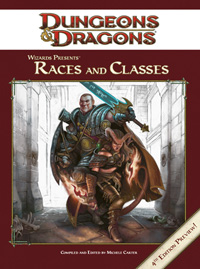
As a veteran DM of the 3.0/3.5 era, their choices for which races and classes to include are at the same time surprising and reassuring. Their picks have definitely shaken up the status quo, bucking traditions that date back to the late 80's. The Gnomish race, for example, won't be in the first Player's Handbook. Half-Orcs, one of the favorite races of the current edition, won't be addressed until the Forgotten Realms sourcebook in the Fall.
Instead, standbys like the Elf, Dwarf, and Hafling have been refined and polished to clarify their place in the world. Haflings in particular have been given a fictive solidness they previously lacked: they're now a nomadic boat-people, tending to the waters in the same way the Elves tend to forests or Dwarves to hills and mountains. New additions to the racial roster fill in gaps that have been patched previously in non-core supplements. The Dragonborn race, a reptilian species, is the most obvious of these. Previous 'dragon-ish' races have fit into campaign worlds roughly compared to the core races. Tieflings (half-demons) are another example of this trend. A popular player race in 3.0/3.5, it was challenging to play a Tiefling because of restrictions at character creation.
The process of making and growing a character seems to be the element they examine most closely in the commentary sections of the book. One subheading says it all: "Expanding the Sweet Spot". 3.0/3.5, it has often been noted, follows a power curve that starts somewhat underpowered and eventually reaches a point where players are too powerful to be seriously challenged. Though there's a lot of debate on this point, personal experience suggests the sweet spot for D&D 3.5 is about 5th level to 14th. Though many campaigns will never make it that far, it's frustrating to deal with mechanical weaknesses like that over the lifespan of a game. Fourth edition is a valiant attempt to rectify that by making all levels viable for play.
For a player, viability essentially boils down to "fun". At any given moment, is the player having fun at the gaming table? The Classes they've chosen for core inclusion speak directly to the need for fun. While the Core Four (Fighter, Cleric, Rogue, Wizard) are there, they've also included a number of fun tweaks for additional classes. In 3.5 hybrid classes were rough to play; why would you want to play a Paladin (a weak fighter bolted to a weak cleric) when you could play one of the core four and do something well? Fourth edition solves this issue by looking at the roles behind the classes rather than at class particulars. The Rogue, for example, is the classic Striker. He uses stealth and guile to cause spikes of high damage at opportune times. But that's not the only interpretation you can have of that role; the Warlock (another fourth edition core class) is also a Striker, but he relies on Damage over Time spells and arcane blasts to do his job. The Cleric is the classic Leader, keeping his allies up and in the fight by tapping into a spiritual power. The Warlord does the same through discipline and sheer force of will; the same role, but with a different interpretation.
The real advance is that each class role should always have something interesting to do in a fight, because every role is defined. If you're a Defender, and you're not interposing yourself between the bad guys and the party, you're doing it wrong. That great start is expanded by the inclusion of 'powers'. Previously the domain of spellcasters only, powers are going to be a staple for every class. Instead of the Fighter being forced to dully repeat "I hit it" over and over again, every class will have unique moves and attacks that support their role in the party. And if the Warlock (with powers labeled things like hurl through hell or iron chains of misery) are a good representation, each class should be a lot of fun to play.
I've been reading information about fourth edition greedily since last year on the D&D Insider site, and I thought I had a handle on what this game was going to be like. The class book, though, has been an eye opening experience. The designers just 'get it'. Everything that gets in the way of having fun needs to be excised. This book illustrates that, fundamentally, the WotC designers understand that. In 3.5 Fighters have too few options and Wizards have too many. Fixed. In 3.5 race didn't fundamentally matter, and on top of that each race was fairly poorly defined in the core books. Fixed. In 3.5 class roles were a challenge to understand for new and old players alike. Fixed.
Reading this text read like an answer to every player frustration I've experienced in the past 9 years. The game they describe in the pages of "Races and Classes" sounds like an intrinsically different experience than Dungeons and Dragons 3.5. For some people it's not going to be what they're looking for. For me personally, it's everything I could have hoped for and more. It's always been easy to have fun roleplaying; if they can make character creation fun? If they can make combat purely fun? That's an innovation worth rebooting the system for.
My only complaint with this book is the price. For more on that, please read on.
Worlds and Monsters
Compiled and Edited by Jennifer Clarke Wilkes
95 pages
Published by Wizards of the Coast
Rating: 7
ISBN: 9780786948024
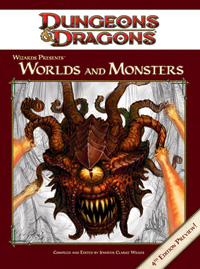
For Dungeon Masters, this is far and away the more fascinating book. This stand-in for the DMG speaks directly to the storytelling core of the game, and hints at the kinds of high-adventure tales we'll be able to craft later this year. The game world sounds quite interesting, both for its specificity and its vagueness. Races, for example, are quite specifically outlined. Tieflings, Dragonborn, Elves ... all have specific creation stories that PCs can share as a common background. Racial traits stemming from historical events will add a lot of texture to character portrayals. At the same time, much of the world is being left deliberately vague. This setting is described just enough to hang plot hooks on, but not enough so that as a DM you'll have to deal with backstory cruft.
The world they describe sounds quite interesting, too. They're calling the core concept "Points of Light". Adventurers are heroes living in a world mostly covered by the darkness of wilderness and the unknown. Small cities and villages dot the landscape, providing shelter and a bright spot in this darkness. The wilderness hides numerous ruins, leftovers from the rise and fall of ancient civilizations. The last great human empire fell about a hundred years ago, in the setting, and the result is something akin to the historical dark ages. Layered on top of this ruin-strewn landscape is a faerie realm, accessible via special holes in the world. Monsters live in the deep woods, and dark magics are hidden underground. It sounds like a great place to adventure.
The monsters section of the book clarifies a number of things about what D&D combat will be like in fourth edition, and speaks again to their goal of 'fun all the time'. 3.5 combat was balanced around the concept of a party fighting one creature of an appropriate level. It turns out? That tends to get kind of boring. Fourth edition combat, instead, is balanced around an equal number of opponents for the players. Having the concept of 'slots', where monsters oppose players on equal footing, and roles (not unlike PC roles) ensures that fights will be actually challenging. 3.5 fights tend to be either bloodbaths or total routs, with little room in-between for contesting the outcome.
That concept of roles has been applied to monsters quite deliberately. Balancing a monster party with Defenders, Skirmishers, Controllers, and Leaders will result in a mixed bag of interesting critters. Monster races that tended toward the generic have even been given a degree of specificity. Instead of Gnolls just being Orcs with Hyena masks on, they'll now apparently fight with pack tactics and cowardly tricks. Giving flavour to the opposition seems to be the basic idea: off-the-rack encounters will no longer feel so rote.
Again, the game they're describing sounds like a lot of fun. My frustration with this text was high on the price side, though. While the "Races and Classes" book speaks directly to the core of the new D&D game, and is a great book to throw at someone still griping about the lack of Gnomes, "Worlds and Monsters" seems like it's mostly a lot of set dressing. Set dressing which (I can only assume) will be reiterated in more detail in the core books. Did I enjoy reading it? Of course. It's interesting stuff. But twenty dollars for set dressing is hard to swallow, especially when we're going to have to repurchase that information in the DMG for another thirty bucks.
At a cost of forty dollars for the pair, it's hard to say if the extremely interesting content is worth the price of admission. In podcasts and commentaries WotC has said how they enjoy the 'DVD extras' model, where consumers pay a premium for 'behind-the-scenes' info. If you really enjoy that kind of content, or just can't wait the next four months for the core books, these will be easy buys for you. The ideal would have been if purchasing these books represented preorders for the core books. Pay $40 now, buy the core books for only $20 each? Anything to make this investment last past May? Instead, we're left with the reality that nothing in these books can't wait until June.

D&D (Score:2)
Something else not to miss- (Score:4, Interesting)
http://www.wizards.com/default.asp?x=dnd/welcome&dcmp=ILC-DND062006FP [wizards.com]
Am I the only one... (Score:5, Interesting)
I mean, you can make Monopoly a lot easier to play and simpler to learn if you ditch hotel and house building, the rent for each property is the same, and instead of rolling the dice to move you move one space each time on your turn, but would it be fun?
3/3.5E's not perfect by a long shot to me either, but what we've seen of 4E so far is honestly just not interesting to me.
Re: (Score:3, Interesting)
Re:Am I the only one... (Score:4, Interesting)
Layne
Re:Am I the only one... (Score:5, Interesting)
I call shenanigans on the 3rd ed has no value. 2nd Ed's problems werent't complexity, they were A) the degree of crippling limitation built into the system (especially the weapon proficiencies system) and B) the places where abstractions failed to either simplify reality or reflect it in any way.
Also, the flight rules for second edition D&D are the worst thing I've ever read in a roleplaying system, including HoL, which is a parody system.
That being said, I totally agree with you on the creative roleplaying aspect. A good group fixes (or has the potential to fix) any system. That being said, rules sets do have relative strengths and weaknesses, and can be useful shortcuts. The D&D family have always been strong in two areas: abstraction of combat, and relative completeness of physical modeling. Thinking of RPGs as languages, D&D is one where you can do combat fast (relatively), and you can mostly cover whatever a player wants to do under the rules. The rules make it easier to run dungeon crawls in an arbitrary world than it would be in, say, White Wolf's Mage.
If you want to run a social game... it's not really helping you out much.
Re: (Score:2, Insightful)
D&D have always been more like a dice game anyway...
Re:Am I the only one... (Score:5, Insightful)
I've gone completely rules-light. My PBEM is based on Palladium's Rifts environment (now there's a rule-heavy *and* rule inconsistent gaming system, what a fucking nightmare), but I use it pretty much as a backdrop. The horrible combat system has been boiled down almost beyond recognition, and the character stats are largely there to help the players define their characters.
The best roleplaying experience I ever had was when I was sixteen years old and we were playing Twilight 2000, and, for whatever reason, we dispensed with most of the rules. The GM just sort of winged it, and it was infinitely more exciting and liberating than sitting there going through tables and calculating damage and so forth.
Re: (Score:3, Insightful)
Other players want a more free-form, story-teller type approach, and for these, a light ruleset with a system that is i
Re: (Score:3, Informative)
Ten minutes?
Thats *nothing*
Try Aftermath; half an hour to work out how much damage a single shot will do... You practically have to be a ballistics expert to run the game.
Re:Am I the only one... (Score:5, Funny)
You know, you buy a pack of rules, then you have to buy a booster pack of rules if you want to play them in the DnD setting.
"Damn, I was really hoping to get Cleave in this pack."
"Awesome, Whirlwind Attack!"
Re:Am I the only one... (Score:4, Interesting)
Re: (Score:2)
I suspect one of the two groups I play with will adopt 4ed. If that happens I'll probably leave a gaming group I've been with for about 24 years. Everything I've read about the 4ed rules leads me to believe that it will be complete crap. I'd like to keep my EQ/WoW separate from my D&D, thanks.
Re:Am I the only one... (Score:5, Insightful)
Re: (Score:2)
It's still speculation to me at this point. I intend to give 4ed a fair chance once the actual rulebooks come out. It's just that what I've heard and seen so far has not been promising.
Re:Am I the only one... (Score:5, Insightful)
Neither of us know what the mechanics are going to be like, but from my perspective you couldn't be more wrong. I don't know specifically what you're talking about when you say "the most interesting parts", but the parts that they've confirmed aren't there anymore are the parts that always bothered me the most - like the way any dungeon adventure longer than four encounters stops being "let's go have adventures" and becomes "we need to find a way to sleep."
I mean, my idea of heroic fantasy doesn't include a desperate search for a Motel 6 (or, God forbid, a magic spell that simply creates one.) So the new spellcasting mechanic of "at-will" powers sounds pitch-perfect to me. But, at the same time, a few of the powers are attrition-based, too, so having to decide whether or not to blow your big spells now or save them for something even more tough is still there.
The more I hear about 4th Edition the more I wish it was the D&D I was running right now. As it is, every single one of my players now has at least one maneuver , if not their class or PrC, from Book of the Nine Swords - which is sort of prototype 4th Edition in some ways - and I think that speaks volumes. My players don't even want to sleep in dungeons, that's how stupid it feels to play that way, and they've all, independently, gravitated to ways to keep the power level up without using attrition powers.
I don't know what it means to "fill the gaps liberally with WoW", except as far as WoW simply game-ified what players and DM's were already doing. Maybe you could elaborate on that.
Re:Am I the only one... (Score:5, Interesting)
Some of it for me is certainly in resource management, which from the rest of your post is something I can tell you don't particularly enjoy. I really like prepared spellcasting (AKA memorization), although I also like that you can play spontaneous casters if you choose. I really like the variety of having some characters in a group that are on a fairly even keel of power where others have only a few moments of greatness throughout a day (often, many fights) that they have to carefully hoard and marshal at appropriate times. I like that there are a ton of feats and spells and things in the game that are combat-important but don't deal damage, such as sleep or entangle. I like that you can play a wide variety of characters that all feel/play really different.
This isn't meant to be an exhaustive list, but everything I know so far about 4E suggests that some of these things are going outright and others are being diminished in importance severely, and that we're moving more to a game where everyone's got a bunch of 'once per encounter' abilities, and every fight of their career involves every character firing off their toughest ones in succession. In other words, choosing nearly the same sequence of actions in nearly every fight.
I don't know what it means to "fill the gaps liberally with WoW", except as far as WoW simply game-ified what players and DM's were already doing. Maybe you could elaborate on that.
Things like: pushing more to an 'everyone does damage' model vs. non-damaging malediction/battlefield control, or designing classes more along the MMORPG 'holy trinity' of tank/healing/DPS. The 4E rogue sounds like the typical MMO DPS-machine; the 3E rogue, I would argue, is more defined by his skills -- especially since as his level increases the number of sneak-attack-able enemies he typically encounters drops drastically.
Re:Am I the only one... (Score:5, Insightful)
I like it just fine right up to the point where it ends the adventure for everybody else at the table. They're certainly not getting rid of resources, by any means; if you haven't already you should play with the Book of the Nine Swords material to get a sense of what it's going to be like. That sense of managing resources and preparing abilities is still there, but my swordsage doesn't have to guess what he's going to need for a whole day's worth of adventuring - and he's not in desperate need of 8 hours of rest after only four battles - but he still has resources he needs to manage, and the choice to prepare one maneuver means that another can't be used when it really would have mattered.
I really like the variety of having some characters in a group that are on a fairly even keel of power where others have only a few moments of greatness throughout a day (often, many fights) that they have to carefully hoard and marshal at appropriate times.
If you're the second guy, though, you may not understand how the first guy feels. Maybe he's not as excited by the idea of doing nothing more than hitting with his 1d12 greataxe every round while everybody at the table cheers when the wizard picks up ten d6's for fireball damage. Sure, monopolizing the show-off power is good if you're the guy who gets to have it, but there's 2-4 other people at the table, and they'd like a chance to show off once in a while, too. "Ol' reliable greataxe damage" isn't much fun when the wizard is bending reality to his very whim, as much fun as that is for you.
Nonetheless, if you want to play a character with reliable, constant power, I don't think that's going anywhere.
I like that there are a ton of feats and spells and things in the game that are combat-important but don't deal damage, such as sleep or entangle.
Not going anywhere, and they're adding mechanisms for non-combat encounters, like social encounters. So I don't think you have anything to fear, there.
I like that you can play a wide variety of characters that all feel/play really different.
I can't imagine that's going anywhere, either. Book of the Nine Swords gets maligned sometimes as "spells for fighters" but that's really not at all what it's about; ultimately, there's not much difference from the martial maneuvers in B9S and using a feat like Whirlwind Strike.
This isn't meant to be an exhaustive list, but everything I know so far about 4E suggests that some of these things are going outright and others are being diminished in importance severely, and that we're moving more to a game where everyone's got a bunch of 'once per encounter' abilities, and every fight of their career involves every character firing off their toughest ones in succession.
I just don't get that sense. It certainly isn't that way in 3e now, wizards don't blow their toughest spells one after another in the same order for the day's encounters, and it certainly doesn't work that way in B9S, where you really have to set yourself or the situation up to get the best use out of your per-encounter power or you've wasted it. And there's still a daily-use power system, too; it's just not that every power is per-day. In 3e running out of per-day powers, like spells, is the end of the delve. Period. In 4e it sounds like running out of per-day powers doesn't leave you so powerless.
Things like: pushing more to an 'everyone does damage' model vs. non-damaging malediction/battlefield control, or designing classes more along the MMORPG 'holy trinity' of tank/healing/DPS.
The healing/tank/DPS was already in Dungeons and Dragons, though; that's why it's in so many fantasy video games. And honestly, tanking and DPS'ing are fun, and they should be in the game just like they've always been. Healing isn't much fun at the table-top, and the
Re:Am I the only one... (Score:5, Insightful)
Re: (Score:3, Interesting)
There's no game in searching for traps, it's just a skill roll vs. a DC. There's nothing tactical about it. Same with locked doors.
Depends on how it's done. To be sure, traps and locks that are simply laid on the map (i.e. this door is locked, that stairway has a trap) are just tedious DC rolls. The DM I'm currently playing has created a fairly trap & lock heavy campaign (Indiana Jones in the South American temple^2). The key to making traps more interesting is make them seem real. OK, so you found the 20x20 foot counterweighted trap door that will drop you 40 feet into icky water fill of eels--- how do you intend to get past it?
Re: (Score:3, Interesting)
This was in second edition.
It was pretty popular, and we used it for years until we finally diverged from D&D all together into systems of our own de
Re:Am I the only one... (Score:5, Interesting)
I'm very active in the Role-Playing Felllowship of Greater Boston [meetup.com] and lately we've been trying many new things. Probably my favorite is a small indy system called Universalis [indie-rpgs.com], a GM-less collaborative roleplaying/storytelling system which uses a set of simple socioeconomic feedback mechanisms to regulate the narrative and resolve conflicts without any centralized authority. This has the effect of making the game much more about creativity and interesting stories (indeed the game itself "pays" you to create conflicts in the story) than about playing what is essentially a video game on pen and paper. In a manner similar to brainstorming, Universalis combines the intellectual and creative abilities of the players in such a way that other players act as randomizing agents on your ideas, taking characters and story elements in directions that you yourself would have never thought of. I think it's absolutely brilliant, and indeed a feasible system for brainstorming and generating new and unique stories.
If you live in the Greater Boston area, you should check us out. It's one of the few places you'll find roleplayers willing to try just about anything.
Re: (Score:3, Insightful)
... who feels like they may have simplified the most interesting parts clear out of the game, filled the gaps liberally with WoW, and ended up with a game that, admittedly, has a much lower barrier to entry but is also not particularly interesting?
That is what I felt began with D&D 3e, but unlike this time, I felt that sort of change was needed. D&D 3e ended up pretty nicely IMO, and 3.5 touching up some of the problems and adding minor improvements to some other things. It started feeling quite mature. Then this arrived. :-S No, I can't say I'm sitting on nails with my expectations up.
Re: (Score:3)
Let's look at some of D&D's fundamental design problems:
1) Classes -- this is a really bad idea, it doesn't match reality or fiction. Even in official adaptations, no fictional character from source literature (e.g. Fafhrd and the Gray Mouser, the
Developer commentary is a must-have? (Score:2, Interesting)
suggestions ... (Score:4, Interesting)
Is there a computer game out there that can give me that nostalgic experience? Or will I have to buy the books and get a group of like-minded geeks together for old times sake?
Re:suggestions ... (Score:4, Informative)
Layne
Re: (Score:2)
NWN also lets you get back in a game with your old D&D buddies no matter where they are. NWN 1 has such a low entry barrier these days nearly any laptop can handle it. Add Teamspeak and some good whiskey and you'll have a blast even if you're just playing some random non-DMed module.
It's also nice that your buddies won't be playing on their own and leveling up way beyond the rest of the party.
Re: (Score:2)
I completely agree with you on NWN1. As for NWN2, most everyone considers multiplayer to be a complete disaster. Crashes and playability bugs are common. Hopefully the next patch will drastically improve the state of mult
NWN + LAN (Score:2, Interesting)
IMHO, one of the worst things about pen and paper is the sheer amount of time it takes to get through battles. With NWN most encounters are over in seconds. H
Re:suggestions ... (Score:4, Interesting)
I'm actually a bit curious about this aspect. I've recently moved, and unfortunately had to leave my gaming group behind. In the meantime, I've turned a few acres of my property into a nice pen and paper gaming area (Deck, grill, 2 room building for when it rains). It is great for bringing together the old gang for some planned weekends, but for most of them its at best a 3 hour drive. I'm looking for some more regular players rather than the 3x/year events we currently plan.
Slashdot seems as an appropriate place as any to ask, Has anyone come across a good bulletin board, or method of finding a new group of 'geeks'? Have any of you met with any success?
Re: (Score:2, Informative)
Re: (Score:2)
Re: (Score:3, Interesting)
Usually over the course of a day/weekend/whatever you'll get to game with different handfuls of people at a time. Even if you decide the con scene isn't to your liking, probably you'll get to game with some people that you get along with and would like to play with again, and some people you don't. Talk to the people you do enjoy playing with and there you are.
Re: (Score:2)
Planescape: Torment will sort of hit you in a similar spot, also.
Note: if you treated the 2nd edition AD&D books as sourcebooks, they were OK to add to a 1st
Re: (Score:2)
Which is why I tagged it
Re: (Score:2)
Neverwinter Nights 2 and more recently The Witcher are both decent games but fall into the category of games where gr
Neverwinter Nights (Score:2)
These days I'm working on a new campaign [adamandjamie.com] for NWN2. The new engine is more challenging to work with, but it's quite pretty. I'm able to give my new computer quite a workout with
Re: (Score:3, Interesting)
http://www.atlus.com/etrian/ [atlus.com]
What it needs (Score:5, Insightful)
1: The keywords here are "simple" and "straightforward". The current grapple rules are painful, many conditions make no sense (can a construct be nauseated? the answer may surprise you), and what exactly does polymorph do these days? You don't know. No one knows. It's been errata'd like eight times. If a rule takes longer than two or three sentences to explain, people have already stopped caring.
2: Fix stacking and inherited bonuses. The days of sixteen different kinds of bonus all adding up to push a character WAY off the random number generator have to end; at the same time, feats that provide an advantage so small you frequently forget about it also must end. Feats and abilities need to provide meaningful options without turning rolls into "no lose" situations.
3: Get rid of gold = power. The 3.5 conceit of assuming characters of level X would have Y gp worth of Magical Stuff ruined a lot of flavor and a lot of system. Let the GM handle the distribution of magic items, and let the PCs spend their gold the way it was intended: on ale and whores.
4: Fix the phrase "level appropriate ability" firmly in mind. At every level, every character should gain new abilities appropriate to that level. Every one. It's WAY too easy in 3.5 to fall off the level appropriate ability train for life.
5: Want to playtest? Recruit the twinkiest, most outrageous powergamers you can find. They're the ones that spot inane bullshit like Balor mining, chain-binding djinni, and the truly stupid amount of awesome that 3.5 clerics and druids bring to the table.
Since based on what I've heard so far, not one of these is actually happening (with the possible exception of #1), I am not optimistic.
Re: (Score:3, Insightful)
http://www.feartheboot.com/comic/default.aspx?c=23 [feartheboot.com]
Re: (Score:2)
3: Get rid of gold = power. The 3.5 conceit of assuming characters of level X would have Y gp worth of Magical Stuff ruined a lot of flavor and a lot of system. Let the GM handle the distribution of magic items, and let the PCs spend their gold the way it was intended: on ale and whores.
I really can't help but think that mirroring RL isn't the greatest idea in the world. [/obligatory comment on geek lack of action]
5: Want to playtest? Recruit the twinkiest, most outrageous powergamers you can find. They're the ones that spot inane bullshit like Balor mining, chain-binding djinni, and the truly stupid amount of awesome that 3.5 clerics and druids bring to the table.
In general that's the best way of going about things. I seem to recall magic having quite a few of these sorts of problems as well that had to be corrected.
There's probably always going to be somebody that prefers this sort of complicated game to less complicated choices like computer games or LARP, but it's got to be meaningful details rather than an exercise in how many rules
Re: (Score:3, Informative)
Then you should pay better attention. When I was reading your post, I assumed you were making a list of what they were doing right, because based on what I've heard so far, they're doing all those things. Grapple cleaned up, stacking bonuses cleared up (by simplifying and clarifying item slots mostly), the effect of gold->magicitems->power weakened (again, mostly through magic item slots, but through other means too), l
Re: (Score:2)
"Primary Slots: We've preserved a number of items that have traditional "plusses." Thes are the items we expect everybody to care about, and the ones that are factored into the math behind the game. If you're 9th level, we expect you to have a set of +2 armor, and the challenges in the game at that level are balanced accordingly. Here are the primary item slots:"
There are 3; weapon/impliment (think wand staff or rod), armor, neck (amulet or what
Re: (Score:3, Informative)
You must not be listening, then, since they're actually doing every single thing you mentioned in your list.
1) Grapple and other complicated rules are being totally revamped, though they haven't said how.
2) Static bonuses to stats are pretty much out - not from spells, not from magic items. That leads to...
3) Since magic items no longer provide static benefits to stats, you no longer have to have stat-improving magic items just to
Re: (Score:2)
I don't know, man. I remember all the sharpest super-twinks I know declaring that in 3.0 druid was either the flat-out toughest or in the running for toughest class (depending on who you asked), and 3.5 made them tougher. The word on the street (which I believe but can't vouch for the truth of) was that in the internal games at WotC no one really wa
Re: (Score:3, Interesting)
Wild Shape is so stupidly great, it makes me cry real tears when I play other classes. Okay, it takes a feat slot to cast while wildshaped. Big whoop, every druid ever born takes that feat because it's a ticket to winsville. Wild shape is the privilege, the right, indeed, the DUTY to dumpster-dive through every Monster Man
Re: (Score:2)
2000 (Score:2)
I have thus far only ever been to one GenCon, and it was in 2000, and there was a big rush for the new edition. I remember it well. Scarred Lands was released to capitalize on this, and Exalted was postponed for another year because White Wolf didn't want to release their new fantasy game in direct competition with D&D.
Online Tools (Score:2)
Many moons ago, I spent some time trying to write up some tools to generate characters in dungeons and dragons, to generate realistic sounding names. Shameless plug http://www.kirith.com/ [kirith.com]
I really thought back then that the online community would kind of take over. Have something like a wiki setup for role playing rules.
Ouroboros (Score:5, Interesting)
Spend our reward... (Score:5, Funny)
Adventurer 2: I spend mine on ale and whores...So you know cure disease?
I don't care the version, you won't lose some of the best "non-battle conversation"
What happened to the interview? (Score:5, Insightful)
Re:What happened to the interview? (Score:5, Funny)
tl;dr (Score:5, Insightful)
Because you're ROLE-PLAYING. Aren't you? You aren't just rolling dice and putting the business end of a sword into randomly-generated monsters to acquire their gold and +2 swords (+4 vs. randomly-generated monsters), are you?
Re:tl;dr (Score:5, Interesting)
Honestly, there's power-gaming, and then there's just wanting to be a useful member of the team. Not everyone has the teenage fixation on being the toughest guy, but I think most people like to feel more like a contributing part of the group and less like the soldier with two broken legs whose comrades are slowly dragging back from enemy lines at great risk to themselves.
Roleplaying does not require sucking in combat. (Score:4, Interesting)
Why do some people think that you can only RP if you pick a sub-optimal character?
Re: (Score:2)
Re: (Score:3, Insightful)
The default assumption of D&D is that I'm a fantasy hero, going forth to stop the forces of darkness, mostly by killing them. I want to role-play such a hero, fending back hordes of monsters. When I stand with my fellow party members, I want to be one of equals, not the spearcarrier. Paladins are supposed to be powerful holy warriors, different, but equal to warriors and clerics. If the game doesn't support that premise you've got a problem.
Standard WotC cash grab (Score:5, Insightful)
In short: they're must-haves for hardcore D&D fans.
I'll bet there isn't anything worth justifying the price of the new books in there if you look at it honestly.
Called "Races and Classes" and "Worlds and Monsters", the two titles cover everything from character creation to the new default world's pantheon.
They've done that dozens of times. Races and Classes was originally called Player's Manual back when I was a kid. The pantheon book was Deities and Demigods, or optionally Greyhawk. It's been done and done and done.
This is what WotC does. Take it out, polish it, change things just enough to be incompatible with the last version, and resell. Expensively. Look at Magic the Gathering for another example. Each expansion came out with something that would absolutely devastate the previous versions - to stay current you HAD to keep buying it. And for tournament play you weren't allowed to use older sets either. That's why they called MtG Cardboard Crack.
This is just the latest round of "buy this update we need another injection of cash" from WotC. I'll pass.
2.0 - 3.0 (Score:2)
Re: (Score:2)
How many of the complaints about 4.0 were also made about 3.0 between its announcement and release? (MMORPG references naturally aside)
Basically all of them, including allegations that WotC was "pandering to videogamers" and "dumbing down the game"
And you know what? D&D 3.0 was better than 2nd edition, and D&D 3.5 is better than 3.0... (I wasnt there for the 1st-2nd edition shift)
I am definitely buying 4th edition, as I am happy about the changes proposed (many are similar to my houserules)
Re: (Score:2)
Re: (Score:2)
There is no core world (Score:2)
D&D Rules vs Imagination (Score:2)
DM: You are running down the middle of the street. A team of wild black horses pulling a demonic carriage is heading right for you.
Player: I dive
Re: (Score:2)
Based on the comments (Score:2, Insightful)
Maybe this has already been said (Score:2)
Haven't read the comments, and maybe this has already been said, but:
If you need specific instructions to tell you that one race might act/fight differently than another race, remind me not to game with you.
Heh, a different game, D&D by name only (Score:5, Interesting)
Is it the best of the AD&D-inspired RPGs? I don't know, but I don't like what I've read so far. Besiders it will be hard to beat Hackmaster.
Seeing the price of the books, what I would recommend to a beginner is the following: Go to a used book store and buy a set of the excellent hardcover AD&D books by Gary Gygax. Why play immitations when you can play the real thing? I can buy them locally in excellent condition for $10 each. For the DMG, PH, MM1&2 and Unearthed Arcana you will pay $50, but you'll walk away with something substantial, historical and cannonical. You'll also learn about the real spirit of AD&D, which has since been emasculated by various marketeers who tried to cash in on the game (by targeting 11-year-olds). Also, the binding is built to last for decades, unlike the modern glue crap.
Many people are realizing the value of the AD&D, and several game cons are now hosting AD&D tables.
Cut to the chase, and give it to me straight (Score:5, Funny)
Price - Try it before you buy it (Score:2, Insightful)
The price does sound pretty high for what sounds like basically a pair of ads for the upcoming new core books.
Will the contents of these two books be worth much once the core books are out and I pay good money for them as well? (If I do that is...The system sounds a lot like a CRPG. Don't get me wrong; I play and enjoy WoW...it's just not what I'm seeking in a table top game.)
Personally, I'm going to wait until the first scans hit usenet and check them thoroughly before laying down my pair of twenties.
Still For Powergamers... (Score:2)
Re: (Score:2)
3.75ed Books (Score:3, Interesting)
If you can get past the balance issues with those books and the rest of 3.5ed, you can see the basic mechanics and approach that 4e is moving towards. (For those who haven't seen them, the Tome of Magic classes tended to be weak while the Bo9S classes are quite potent, at least compared to their "core rules" 3.5 equivalents)
I'll say that many players love the heck out of the 4e-type classes; they are generally easier to play and tend to always have something useful to do. The warrior classes have some high-damage attacks and special moves that make up for their innate lack of spells. The "magic users" have a smaller list of mostly unlimited use powers that tend to be useful in many circumstances.
The downside is that the magic-using classes are constrained in many ways compared to the traditional wizard or cleric, and that drives some people nuts. The arguement tends to boil down to "warlocks/binders/shadowcasters have less than a dozen powers available compared to the hundreds of spells a caster can prepare." On the other hand, I've never seen someone playing a warlock freeze with indecision the way a mage/cleric player might when staring at a couple dozen prepared spells.
DMs are much more divided but they are also concerned with making those classes work with 3.x games, so there are other factors influencing their opinions. I don't like the ToM and Bo9S in comparison to 3.x but as sample mechanics I'm pleased with them, just so you know where I stand.
Re: (Score:2)
Orcs with Hyena masks...OH MY! (Score:2, Insightful)
Do your monsters just stand there while adventurers come by with a wagon to take their stuff? If that's the case then you fail as a GM.
Tip: Doing some research on monsters you add to a campaign will give you a better idea about how to use them in fights. Even then t
Hack and Slash-vertisement (Score:5, Insightful)
Here are my concerns with 4e:
1. WotC has not responded to the "Ask the developers questions" that have been posted for over a month.... Not a single question.
2. WotC claims to still be playtesting and running into some major issues (War-Forged Palidins are nigh invincable). However, they are preparing to mass produce the books in order to ready for launch in June.
3. WotC wants ~$14.00 subsciption fee to continue to get online updates and erratas.
...a. It will also allow for "virtual tabletop" but from what I have seen, there are open source "virtual tabletop" systems that CURRENTLY offer more flexability... and are FREE!!!
.
4. 4e will introduce "level specific" items. The playtesting reports indicate that at 11th level, a NON-combative character (wizard) is ASSUMED to have +5 bonus to thier armour class....
5. You have to be 11th level BEFORE you can use a ring!!!! You need to be level 21 before you can use a second ring
6. WotC seems to be creating a "digital devide".... The virtual tabletop will contain/replace miniatures... But they want us to buy miniatures as well. To my knowledge, these are mutually exclusive in the 4e gaming environment.
7. Supposedly, WotC will be releasing a NEW Dungeon Master Guide and Players Handbook ONCE A YEAR!!! (however, maybe these will elminiate the need for online errata's???? Not a good deal either way, IMHO)
8. If this is a preview, why do we have to pay for it??? And, to the author, how is that "valuable"?
9. Now we need a new tag for "Hack and Slash-vertisement"
P.S. Please don't use the Gandalf quote of "There are many magic rings in this world, Bilbo Baggins, and none of them should be used lightly." to justify the level dependent rings... unless Bilbo was 11th level or higher at the time. ; )
Re: (Score:3)
Lots of Slashdot interviews take over a month to get a reply. It sucks, but it's hardly fatal.
Will Warforged be part of the initial release? No? Then chill out. There
Are you fscking serious? (Score:3, Insightful)
Seriously? (Score:3, Funny)
Clearly my logical side is shouting them out, but my two reactionary brain cells are screaming something in a knee-jerk fashion about encouraging divisiveness in our society.
Re: (Score:2)
Uh, in what edition would that be? Because it's not 3.0 or 3.5.
Re: (Score:2)
Re: (Score:2)
anyone who hasn't figured that out, isn't paying much attention to the fact that certain challenges tend to favour certain kinds of solutions and not all classes as equal.
if you are faced with countless locks and traps then a rogue is going to seem very powerful. if you face undead constantly then clerics seem the best. if you are always stuck mag
Re: (Score:3, Insightful)
Clerics and Druids, hands down, are the "most powerful" core classes, with probably an edge to druids, because making a good one requires almost no effort.
Overall, it's a reasonably good review that is, in my view,
Re: (Score:2)
The problem with my group is that they don't think through things very well... so when they die, they start making another character, turn their sheet over, and say, "Huh, I forgot I found that potion of healing... probably should have used that."
Give a monkey a tool and he'll just bang himself o
Re: (Score:2)
Comment removed (Score:4, Insightful)
Re: (Score:2)
Re: (Score:2)
Re: (Score:2)
Re: (Score:2)
Are you -crazy-? Paladins are probably the most powerful class in DnD! Oft ridiculed for being the choice of people wanting to play "easymode", both RP and combat-wise.
Druids are by far the most powerful class.
I am a druid. I have special abilities that are more powerful than your entire class! [giantitp.com]
And Clerics are far stronger than Paladins simply because they are full casters. Giving up a few points of BAB and some sub-par abilities to gain 9th-level spells? Yes, please.
The only thing that a Paladin might beat is a Fighter. And Fighters are *terrible*. Tome of Battle FTW!
Re: (Score:2)
In edition 3, paladins get crap spells, and the special abilities don't make up for it. They're all "once a day" crap. What use is that? I can heal a handful of hit points once a day? I have one s
Re: (Score:3, Insightful)
Re: (Score:2)
This is completely true for home play, but if you're into "Living Campaigns" or other tournament/convention-based play, you're more or less stuck with the rules as written. If they bork up the game to the point that it's not fun for yo
Re: (Score:3, Insightful)
I've often pondered why no one has made a software program that could DM once certain parameters were established. It seems AI in gaming has advanced to the point where this is at least feasible. Of course it wouldn't be anything as great as a competent human DM, but for those of us outside large urban centers it would of been a god send.
To DM *well,* it would have to pass the Turing test. The hard part of being a DM is breathing life into your NPCs and your worlds.
(Also, try out Planescape: Torment if you can find it.)
Re: (Score:2)
Re: (Score:2)
What the fuck does the global economy have to do with anything? There was a major recession going on when some of the more famous games like Robotech came out.
Re: (Score:2)
Re: (Score:3, Funny)